What Is Apollo.io?
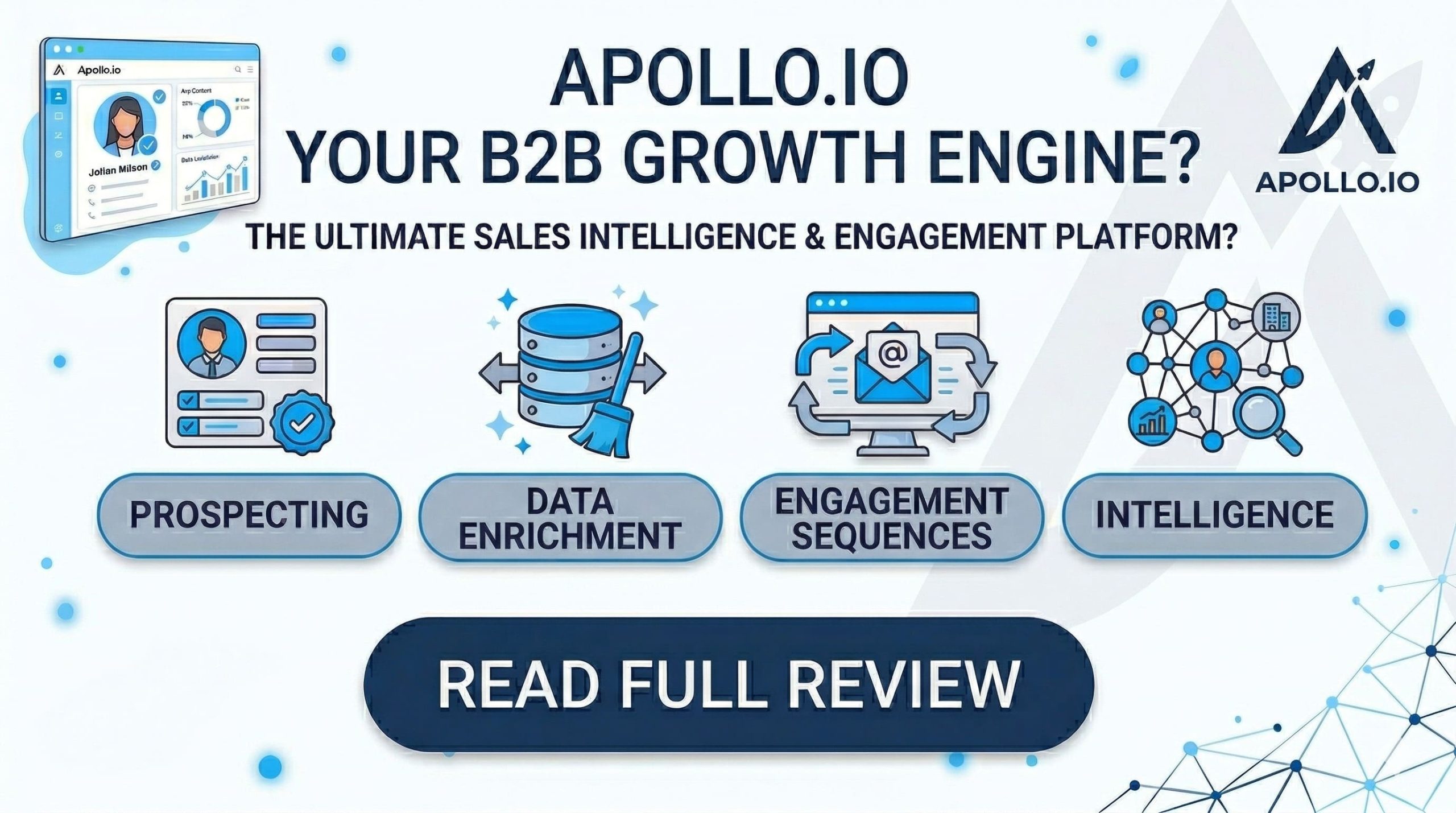
Apollo.io is an all-in-one sales intelligence and engagement platform designed to help sales and marketing teams find leads, enrich contact data, and run outbound outreach — all from a single dashboard. At its core, it combines a massive B2B contact database with built-in automation tools, making it a compelling option for teams looking to consolidate their sales stack.
Trusted by companies ranging from early-stage startups to Fortune 500 enterprises like Ernst & Young, Oracle, and Lyft, Apollo.io has quickly grown into one of the most popular sales tools on the market. On G2, it holds a 4.7/5 rating based on over 9,000 user reviews — a testament to its broad appeal and consistent performance.

Key Features of Apollo.io
1. Massive B2B Contact Database
Apollo.io’s database contains over 275 million contacts with advanced filtering capabilities. Users can search by job title, company size, industry, location, revenue, technologies used, and dozens of other parameters. This makes it straightforward to build highly targeted lead lists in minutes rather than hours of manual research.
2. AI-Powered Prospecting & Lead Scoring
Apollo’s AI capabilities have significantly improved the prospecting experience. AI features help users research accounts, generate personalized email drafts, summarize call recordings, and prioritize leads based on buying signals and engagement patterns. Users note that these features make the platform feel less like automation and more like having a dedicated sales assistant.
3. Email Sequencing & Outreach Automation
The built-in sequencing engine allows teams to design multi-step outreach campaigns with A/B testing, auto follow-ups, and scheduled delivery. Email tracking provides real-time metrics on opens and clicks, and the platform automatically enriches sequences as new contact data becomes available.
4. Phone Dialer
Apollo includes a built-in US dialer starting from the Professional plan, and an international dialer on the top-tier Organization plan. Call recordings and AI-generated call summaries are available on higher plans, helping sales managers review performance and coach reps effectively.
5. CRM Integrations
Apollo integrates natively with major CRMs including Salesforce and HubSpot at no extra charge on paid plans. However, it’s worth noting that each contact sync to external CRMs uses export credits, which can add up for teams with large, active pipelines.
6. Chrome Extension
The Apollo Chrome extension allows reps to pull verified contact data directly from LinkedIn profiles and company websites without leaving the browser. This is particularly useful for targeted prospecting workflows during social selling activities.
7. Intent Data & Buyer Signals
Apollo provides topic-level intent data to help identify companies showing buying signals in your target category. While useful for prioritizing outreach, this feature is more limited compared to dedicated intent platforms, offering topic-level signals rather than precise event-based triggers.
Apollo.io Pricing (2026)
Apollo.io offers four pricing tiers to cater to different team sizes and needs:
| Plan | Monthly | Annual | Best For |
| Free | $0 | $0 | Testing & exploration |
| Basic | $59/user | $49/user | Solo SDRs & startups |
| Professional | $99/user | $79/user | Growing sales teams |
| Organization | $149/user | $119/user | Large teams & enterprise |
Important note on credits: Apollo runs on a credit-based system that controls access to phone numbers, email addresses, and data exports. Email addresses cost 1 credit each, while mobile phone numbers cost 8 credits each. Credits expire at the end of each billing cycle with no rollover or refunds. For teams doing heavy outbound prospecting or cold calling, real-world costs can run significantly higher than the advertised plan prices once credit overages and add-ons are factored in.
Pros and Cons
✅ Pros
- Massive, searchable database with 275M+ contacts and advanced filtering
- Strong AI features that speed up research, email personalization, and call summaries
- All-in-one platform reduces need for multiple separate tools
- Competitive pricing compared to enterprise alternatives like ZoomInfo
- Generous free plan for testing and low-volume needs
- High G2 rating (4.7/5) backed by 9,000+ verified reviews
- Seamless CRM integrations with Salesforce and HubSpot
❌ Cons
- Credit system can lead to unexpected costs — especially for phone number lookups
- Data accuracy inconsistencies, particularly for smaller companies and non-US markets
- LinkedIn features are task reminders only, not true automation
- Steep learning curve for advanced features and workflows
- International dialer locked behind the most expensive Organization plan
- Auto-renewal requires 60 days’ written cancellation notice
- Email bounce rates reported at 15–25%, requiring supplementary verification tools
Apollo.io vs. Competitors
How does Apollo.io stack up against the competition? Here’s a quick overview:
| Platform | G2 Rating | Best For |
| Apollo.io | 4.7/5 (9,000+ reviews) | Startups & mid-market teams |
| ZoomInfo | 4.4/5 | Enterprise data needs |
| Lusha | 4.3/5 | SMBs & individual SDRs |
| Hunter.io | 4.4/5 | Email finding only |
| Outreach.io | 4.3/5 | Sales engagement focus |
Apollo.io vs. ZoomInfo: Apollo is dramatically more affordable. ZoomInfo starts at roughly $15,000/year for an entry-level package, while Apollo’s paid plans range from $49–$119/user/month billed annually. For small to mid-size teams, Apollo offers far better value. ZoomInfo maintains an edge in enterprise-grade data coverage and accuracy.
Apollo.io vs. Lusha: Lusha is simpler and more suitable for individual SDRs or small teams who only need contact data. Apollo offers a far broader feature set including sequencing, dialing, and CRM connectivity, making it the stronger choice for teams looking to scale.
Apollo.io vs. Hunter.io: Hunter.io is laser-focused on email finding and verification. If all you need is to find and verify email addresses, Hunter.io is lighter and cheaper. But Apollo adds outreach automation, calling, AI, and a far larger database.
Apollo.io vs. Outreach.io: Outreach.io is a dedicated sales engagement platform with deeper sequencing capabilities and more robust analytics. However, it lacks Apollo’s built-in contact database, meaning teams would need to pay for both a data provider and Outreach separately.
Our Verdict
Apollo.io is an impressive, well-rounded sales intelligence and engagement platform that punches above its price point. For startups, growing sales teams, and mid-market companies looking to consolidate prospecting, outreach, and CRM workflows under one roof, it delivers genuine value.
The AI features are a meaningful upgrade, making everyday tasks like research and personalization faster and more consistent. The database is extensive, the filtering is powerful, and the free plan is genuinely useful for exploration.
That said, potential buyers should go in with eyes open about the credit system, data accuracy limitations in non-US markets, and the LinkedIn automation gap. Teams planning heavy cold-calling campaigns should carefully model their true monthly cost before committing.
Overall Rating: 4.3 / 5 — Highly recommended for outbound-focused sales teams who want an affordable, all-in-one alternative to enterprise tools.
Frequently Asked Questions (FAQ)
Is Apollo.io free to use?
Yes. Apollo.io offers a free plan with unlimited email credits (subject to fair use), 5 mobile credits, and 10 export credits per month. You can also run two active outreach sequences and use the Chrome extension. It’s enough to explore the platform, but most sales teams will need a paid plan for serious prospecting.
How accurate is Apollo.io’s data?
Apollo’s database accuracy is generally solid for larger companies and US-based contacts, with email success rates of around 70–80% reported by users. Phone number accuracy is less reliable, and data for smaller businesses or non-US markets can be inconsistent. For critical campaigns, supplementary email verification is recommended.
Is Apollo.io better than ZoomInfo?
For most small to mid-size teams, Apollo.io offers better value. It is significantly more affordable and provides a broader feature set including built-in sequencing, dialing, and CRM tools. ZoomInfo’s edge is in enterprise-grade data depth and accuracy, and it may be preferable for large organizations with complex data requirements.
Does Apollo.io integrate with HubSpot?
Yes. Apollo.io integrates natively with HubSpot on all paid plans at no additional charge. However, each contact synced to HubSpot consumes export credits, so high-volume CRM sync users should account for this in their credit budgeting.
Is Apollo.io GDPR compliant?
Apollo.io states that it takes data compliance seriously and has implemented privacy controls including data removal requests. However, for teams operating in highly regulated European markets, it is advisable to review Apollo’s data processing agreements and compare against GDPR-focused alternatives like Cognism, which is purpose-built for European compliance.
What happens to unused credits?
All Apollo.io credits expire at the end of your billing cycle with no rollover, refund, or extension. This makes it important to estimate your monthly credit usage accurately before choosing a plan. Overage credits purchased mid-cycle follow the same expiration policy.